City Unveils Underground Stormwater Tanks on West Side After Reservoirs Nearly Maxed Out
AUSTIN. City officials on Tuesday opened an underground stormwater storage system on the West Side, days after a weekend of near-record rainfall pushed Chicago's flood control reservoirs to the brink and left streets across the South and West sides underwater again.
The project, called Wing Storage, consists of two concrete holding tanks buried beneath residential streets in Austin. Together they can hold about 1.7 million gallons of stormwater, roughly the volume of two and a half Olympic-sized swimming pools. City officials said the system is built to protect nearly 2,900 homes and businesses across the 28th, 29th and 37th wards.
The Department of Water Management and the Metropolitan Water Reclamation District of Greater Chicago built the project jointly. It grew out of recovery efforts following the July 2023 storms that dumped up to 9 inches of rain on the West Side and western suburbs in 24 hours, flooding nearly one in four homes in Austin.
"Communities cannot rely on yesterday's infrastructure to address tomorrow's weather changes. Cities can't always wait for tomorrow to address today's issues," said Randy Conner, commissioner of the Department of Water Management, at the announcement event on LeMoyne Street. "This project represents thinking outside the box to identify new tools for our toolbox in the fight against flooding."
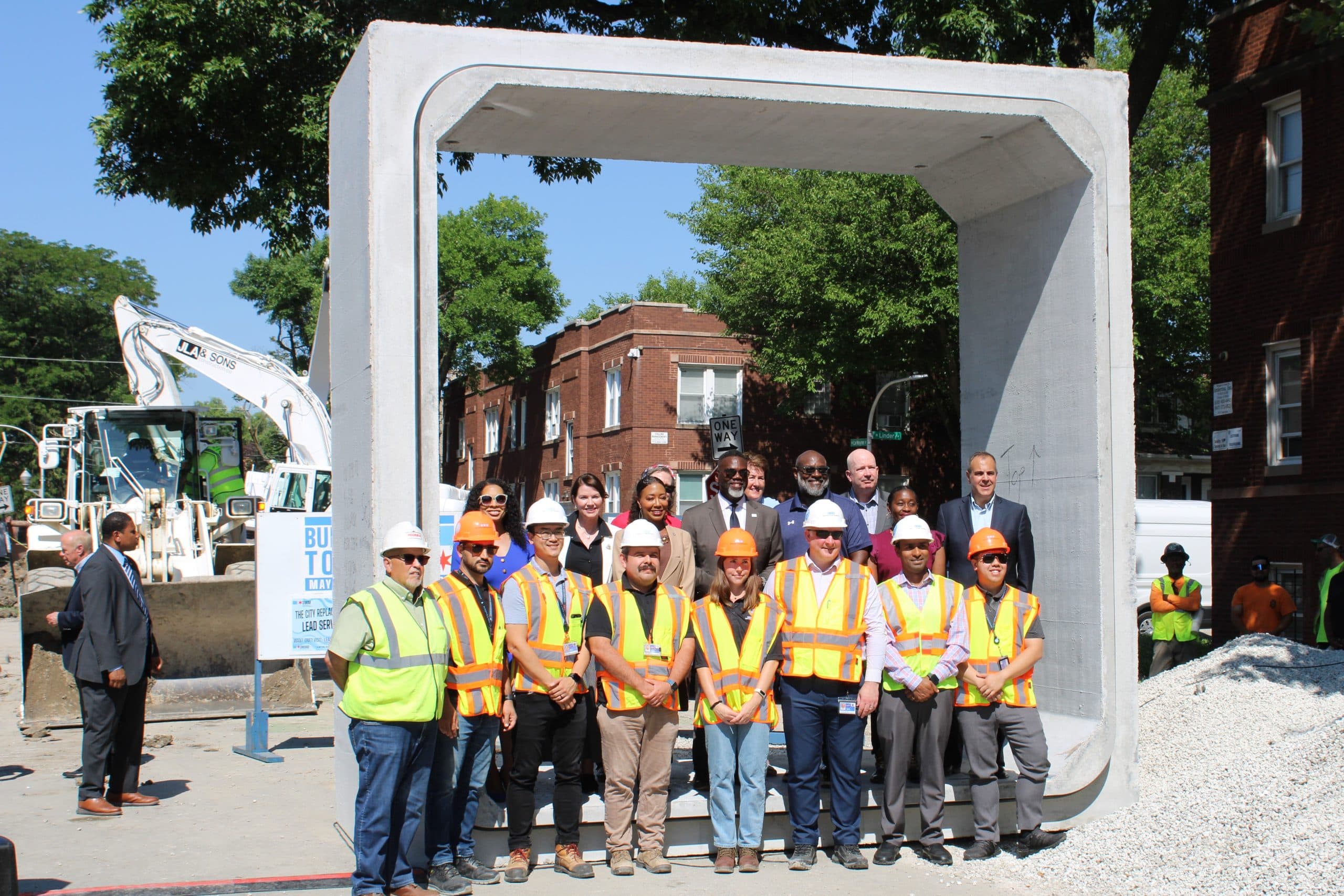
The first of the two tanks sits under a four-block stretch of Maypole Avenue between Cicero and Lavergne avenues and finished construction this spring. The second tank, on LeMoyne Street between Luna and Lorel avenues, is still under construction and is expected to be finished this fall. At Tuesday's event, city leaders stood inside a section of the concrete walls that will form that second tank.
The tanks work by capturing stormwater during heavy rain and holding it underground, then releasing it gradually into the sewer system once the storm passes and pressure on the pipes eases. City officials described the approach as a way to buy time for a sewer system that was not built for the rainfall patterns Chicago now sees.
Metropolitan Water Reclamation District President Kari Steele said the West Side location was chosen based on community feedback identifying "flooding hotspots" after the 2023 disaster. Many Austin residents have said in the years since that they still haven't recovered. In October, seniors in the neighborhood described ongoing mold problems and structural damage to their homes, more than two years after the flooding hit.
Mayor Brandon Johnson called the pilot "an important investment in resilient infrastructure that addresses the impacts of climate change while delivering long-overdue improvements for West Side communities that have experienced repeated flooding," in a statement released alongside the announcement.
The city saw near-record rainfall over the weekend, just days before the Tuesday announcement and almost exactly three years after the 2023 floods that first exposed how vulnerable the West Side is to intense storms. The South Side recorded its second-highest rainfall total since record-keeping began in 1928.
That rain nearly overwhelmed the Deep Tunnel system, the network of underground tunnels and reservoirs built to catch stormwater before it backs up into basements and streets. The Thornton Reservoir, the largest combined rainwater-sewer reservoir in the world, was 95 percent full as of Tuesday morning, according to the water reclamation district. That beat the reservoir's previous record, set in 2019, when it reached 54.5 percent full at more than 7.4 billion gallons. The McCook Reservoir, which serves central Chicago and 36 surrounding municipalities, was completely full as of Monday morning, holding 3.6 billion gallons.
The 1.7 million gallons the Austin tanks can hold is a small fraction of what the region's reservoir system manages. City officials framed the pilot as a way to relieve pressure closer to where flooding actually happens, rather than waiting for water to travel through the sewer network to the Deep Tunnel and reservoirs miles away.
Conner described the tanks as a new tool rather than a replacement for the Deep Tunnel system, which remains the backbone of the region's flood control. The project adds smaller, decentralized storage to a reservoir system that took decades and billions of dollars to build.
City officials did not say Tuesday whether they plan to build similar storage systems in other neighborhoods that flood repeatedly. Construction on the second tank is expected to wrap this fall, at which point the full 1.7 million gallon system will be online for the first time heading into next year's storm season.