One Year After ICE Killed Franklin Park Father, FBI Still Won't Release Investigation Details
FRANKLIN PARK. A year after a federal immigration agent shot and killed Silverio Villegas-Gonzalez during a traffic stop on Grand Avenue, the FBI has not released a single finding from its investigation into his death, and the public still does not know the name of the agent who fired the shot.
Villegas-Gonzalez, 38, a father of two who came to the United States from Michoacán, Mexico, more than two decades ago, was killed on the morning of Sept. 12, 2025, days after the Trump administration launched Operation Midway Blitz, a two-month immigration enforcement surge that led to thousands of arrests and deportations across the Chicago area.
Within hours of the shooting, the Department of Homeland Security said Villegas-Gonzalez drove his car at officers and dragged an ICE agent "a significant distance," and that the agent fired because he feared for his life. But body camera footage from Franklin Park police, released publicly, shows the agent describing his own injuries as "nothing major" just minutes after the shooting. Security footage from a nearby nail salon, obtained by the New York Times, shows two ICE agents approaching Villegas-Gonzalez's car from both sides after pulling him over in a silver Jeep. The agent on the driver's side is not visible in the footage. Villegas-Gonzalez can be seen reversing and then pulling forward before the car crashes into a parked box truck. Audio from a different business recorded what sounded like two gunshots about six seconds after he began moving forward.
Jonathan Manes, senior counsel with the MacArthur Justice Center and the attorney representing the Villegas-Gonzalez family, said forensic evidence the family has reviewed contradicts the government's version of events.
"The gunshot was fired into Silverio's neck downwards," Manes said. "The person who shot him had to have been alongside Silverio's vehicle, not in the path of the vehicle."
Franklin Park police body camera video captured officers arriving at the scene and asking the ICE agents if they were hurt. Then-Police Director Michael Witz told his officers not to investigate, saying it was a federal shooting and the FBI would handle it. Nearly a year later, Manes said, the family still does not know the shooting agent's name or whether any disciplinary or criminal review has concluded.
"It's shocking that a year after Silverio was killed, we still don't know the name of the officer who shot him dead on our streets," Manes said. "Any police department in the country demands more accountability than that."
The Illinois State Police Public Integrity Task Force opened its own investigation into the shooting in May 2026, eight months after Villegas-Gonzalez died. That inquiry could result in a referral to the Cook County State's Attorney's Office for potential state charges. The state's attorney's office said it cannot comment on an ongoing investigation but said it is prepared to bring charges against federal officers if the evidence supports it.
Manes said the eight-month gap before state investigators got involved worries the family.
"In these kinds of investigations, speed can matter," he said. "Evidence, witnesses, eyewitnesses, video. These sorts of things can disappear if you don't get them soon."
The family is now preparing to sue the U.S. government, according to Manes. The Mexican government has said separately that it plans to file criminal complaints related to the deaths of Mexican nationals during immigration enforcement operations, including Villegas-Gonzalez.
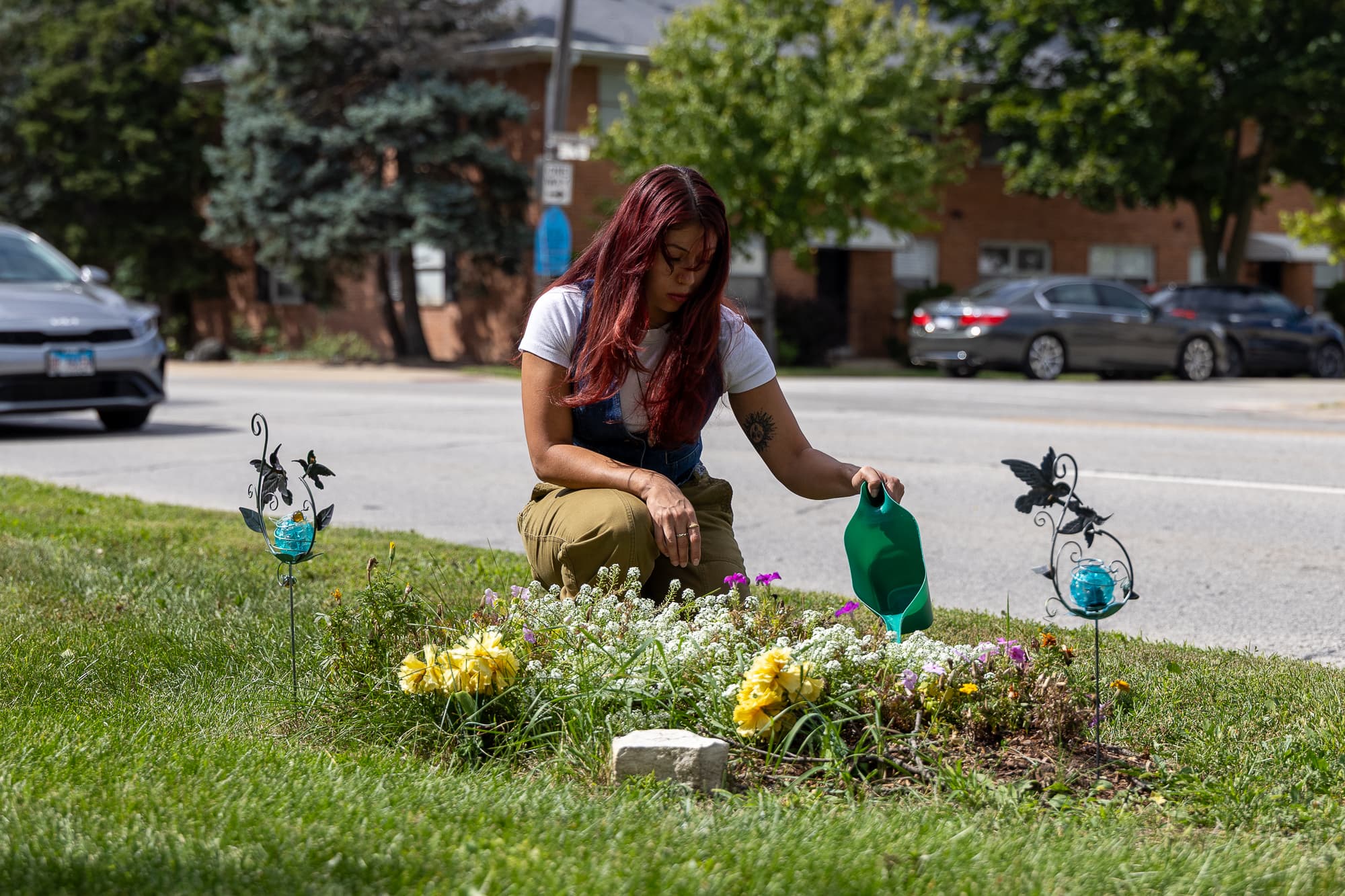
In Franklin Park, a memorial to Villegas-Gonzalez and other people killed in ICE shootings still stands near the site of the traffic stop. Adriana Balvaneda, who co-founded the mutual aid group Hijas del Pueblo in 2024, has helped maintain a vigil there since the day he died.
"Justice might not come today or a year from now, but we know it will come," Balvaneda said. "Our job in the meantime is to make sure they can't change or forget what happened here."
Operation Midway Blitz formally ran for two months last fall. A report from the University of Illinois Chicago's Great Cities Institute found the enforcement surge cost Cook County roughly $1.26 billion in lost restaurant and retail activity.
Manes said the silence surrounding the Villegas-Gonzalez case is not isolated.
"The federal government is acting like it is above the law and they can take lives with no public reckoning," he said.
The Illinois State Police investigation remains open, with no announced timeline for completion or referral to prosecutors. The FBI has not said when, or whether, it will release its own findings.