Rare 'Corpse Flower' Named Alice Blooms at Chicago Botanic Garden, Drawing Crowds and a Foul Smell
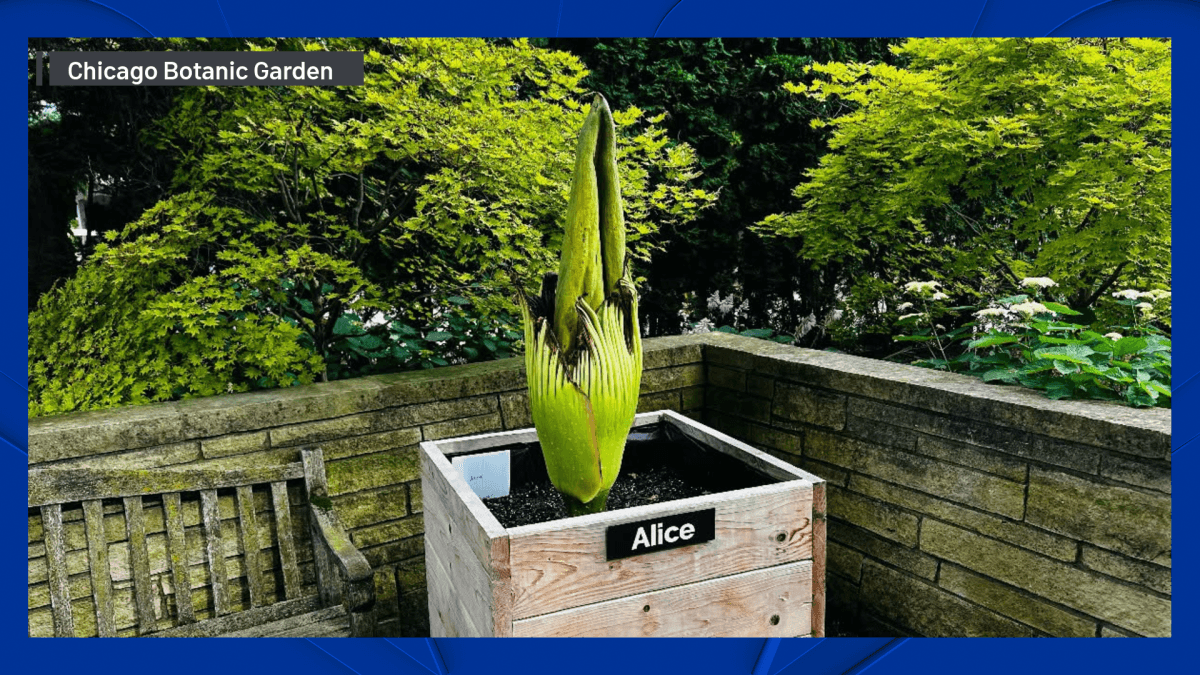
A titan arum nicknamed Alice began unfurling its bloom before dawn Monday at the Chicago Botanic Garden, giving visitors in Glencoe a short chance to witness one of the plant world's odder spectacles: a flower that smells like rotting flesh.
Garden officials said Alice started opening around 4 a.m. and will likely stay in bloom for only 24 to 36 hours. Staff are directing visitors to the Sensory Garden, where the plant is on display in a wooden planter box, standing roughly six to eight feet tall at full bloom.
The plant, known scientifically as Amorphophallus titanum and commonly called the titan arum, is native to the rainforests of Sumatra, Indonesia. It's one of the largest flowering structures on Earth, and one of the least predictable. A titan arum can take five to ten years of growth before it produces a bloom, and even then there's no guarantee. Some plants go a decade or more between blooms, if they bloom at all.
When a titan arum finally does flower, it does so on its own schedule and rarely gives much warning. Growers track the plant's growth spurt in the days beforehand, but the exact hour it opens, and how long it stays open, is hard to predict. Gardens typically post updates as a bloom nears, and visitors arrive in shifts before the flower closes again within a couple of days.
Titan arums release an odor that mimics decaying meat to lure carrion beetles and flesh flies. Those insects, expecting a carcass to lay eggs on or feed from, land on the flower's structure instead and carry pollen from bloom to bloom in the wild. The stench is strongest during the plant's peak opening hours, then fades as the flower begins to close and wither.
The Chicago Botanic Garden has hosted corpse flower blooms before. A previous specimen named Spike drew large crowds and extensive media coverage when it flowered at the Glencoe garden, and video of that bloom remains part of the garden's public archive. Titan arums have become a recurring attraction at botanic gardens and universities around the country, with institutions in Chicago, New York and California each keeping their own specimens and announcing blooms as they happen.
Part of what makes the titan arum unusual, beyond the smell, is the amount of stored energy the plant needs to produce a bloom in the first place. Unlike many flowering plants that bloom repeatedly on a predictable cycle, the arum builds up reserves in an underground corm, sometimes weighing dozens of pounds, over years of leaf growth before it can support a flower structure of that size. The corm's stored energy determines when the plant can bloom again, which is why blooms remain widely spaced and infrequent.
Staff at the Chicago Botanic Garden are encouraging anyone who wants to see, and smell, Alice in person to make the trip to the Sensory Garden soon. The garden said the bloom is expected to hold for 24 to 36 hours from its opening Monday morning, after which the flower will collapse, the odor will fade, and Alice will return to its long growth phase. The garden set no date for its next bloom.