Little Italy's Long-Awaited Columbus Statue Museum Nears Opening as Taylor Street Festa Rolls On
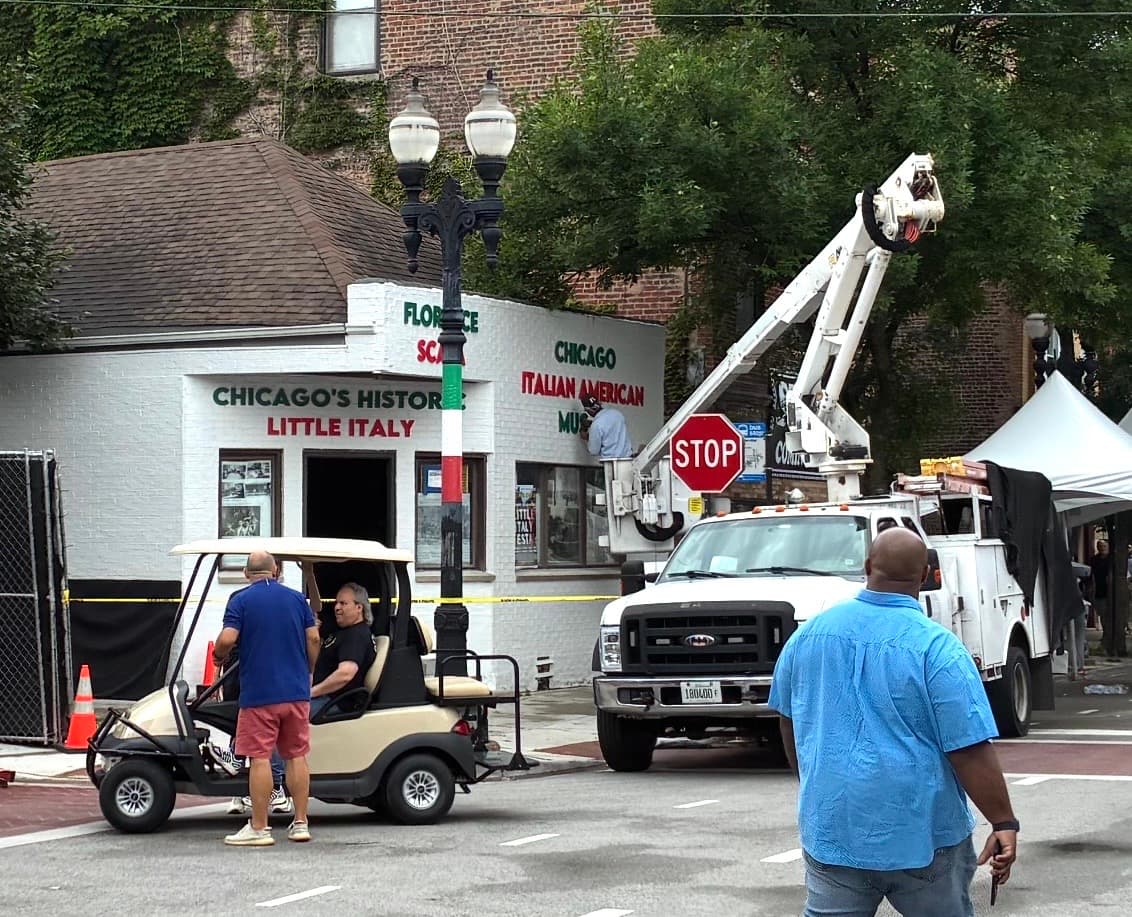
The building at 1501 W. Taylor St. still smells like fresh paint and stored festival equipment, but Ron Onesti walks through it like it's already finished. Crews were adding red-and-green lettering to the white brick facade this week, spelling out "Florence Scala Chicago Italian American Museum," as the Taylor Street Little Italy Festa opened just outside the door.
Onesti, president of the Joint Civic Committee of Italian Americans, is aiming to open the museum on Oct. 12, Columbus Day. If he hits that date, it will close out a fight that has run for more than five years over what to do with the Christopher Columbus statue that once stood in Arrigo Park.
"This is something very special to us," Onesti said Thursday as the festival got underway. "We're only expecting the same respect and sensitivity to something that's important to us as anyone else would with their culture."
The statue has been out of public view since July 2020, when the city removed Columbus monuments from Grant Park, Arrigo Park and the Drake Fountain in South Chicago after protests, vandalism and clashes between demonstrators and police. Protesters said the statues honored a figure whose arrival in the Americas triggered colonial violence against Indigenous people. Onesti's committee sued the following year, arguing the Arrigo Park statue belonged to the group, not the city, because Italian Americans had paid for it in the 1960s.
"Once the statue came down, I started asking questions about who actually owns it," Onesti said. "I found out we had a contract with the city of Chicago that the statue could not be altered in any way without our express written consent, because we actually paid for it. So we eventually came to this deal."
That deal, reached last year, settled the lawsuit by handing the Arrigo Park statue over to Onesti's committee in exchange for the group agreeing to fund a replacement monument in the park honoring Frances Xavier Cabrini, the first American canonized by the Catholic Church. The settlement required the Columbus statue to be displayed indoors. Onesti said he pushed to keep it in Little Italy rather than move it elsewhere in the city.
He found the vacant Taylor Street building in 2024 and has spent the time since on structural renovations. He originally hoped to open in time for this year's festival but couldn't finish the work. Most of what's left, he said, is cosmetic, and he expects it to wrap up in about four weeks.
Getting the statue itself into the building is its own project. The 4,500-pound monument won't fit through the doors or hold up on the building's existing floors, so Onesti's crew plans to cut a hole in the roof and lower the statue by crane onto a concrete platform built into the museum floor, where it will be the centerpiece of the exhibit. The statue is currently being cleaned at a Chicago Park District warehouse. A Park District spokesperson did not respond to a request for comment.
Onesti argues the statue's meaning to Little Italy has little to do with the historical Columbus. "It really has nothing to do with what this guy who lived 600 years ago really did, what he conquered or what he found," he said. "What it's become is an icon of faith and hope for our ethnic group."
The museum will trace Italian settlement in the Chicago area starting in the 1600s, when the Italian-born explorer Henri de Tonti moved through the region with the French military. Most of the exhibit space, though, will focus on the wave of Italian immigration between 1880 and 1970, covering the neighborhoods, food and economic climb of Italian Chicagoans during that period.
The building's name honors Florence Scala, a Little Italy activist who spent years fighting the city's urban renewal plans and the University of Illinois's expansion into the neighborhood in the 1960s, battles that displaced thousands of residents and reshaped what remains of the old Italian enclave on the Near West Side.
The Taylor Street Little Italy Festa, which Onesti's company also runs, continues through Sunday along the strip that still anchors the neighborhood's Italian identity even as the surrounding blocks have filled in with UIC buildings and new development. Vendors, food stalls and the festival crowds are set up steps from the museum's front door, giving Onesti a steady stream of passersby watching the building take shape.
Whether the October date holds depends largely on how quickly the roof work and interior finishes come together, and on the logistics of craning a half-ton statue into a rowhouse-scale building on a commercial strip. Onesti said the structural piece of the renovation is done, which he considers the harder half of the job. The next milestone will be visible from the street: a hole cut into the roof, followed by the statue's arrival by crane, sometime before the museum's planned Columbus Day opening.