Auburn Gresham Street Sign Honors Abraham Bolden, First Black Secret Service Agent to Guard a President
AUBURN GRESHAM. A quiet stretch of South Sangamon Street now carries the name of a man whose Secret Service career put him inside one of the agency's most contested cases: his own prosecution after he raised concerns about misconduct on the presidential detail.
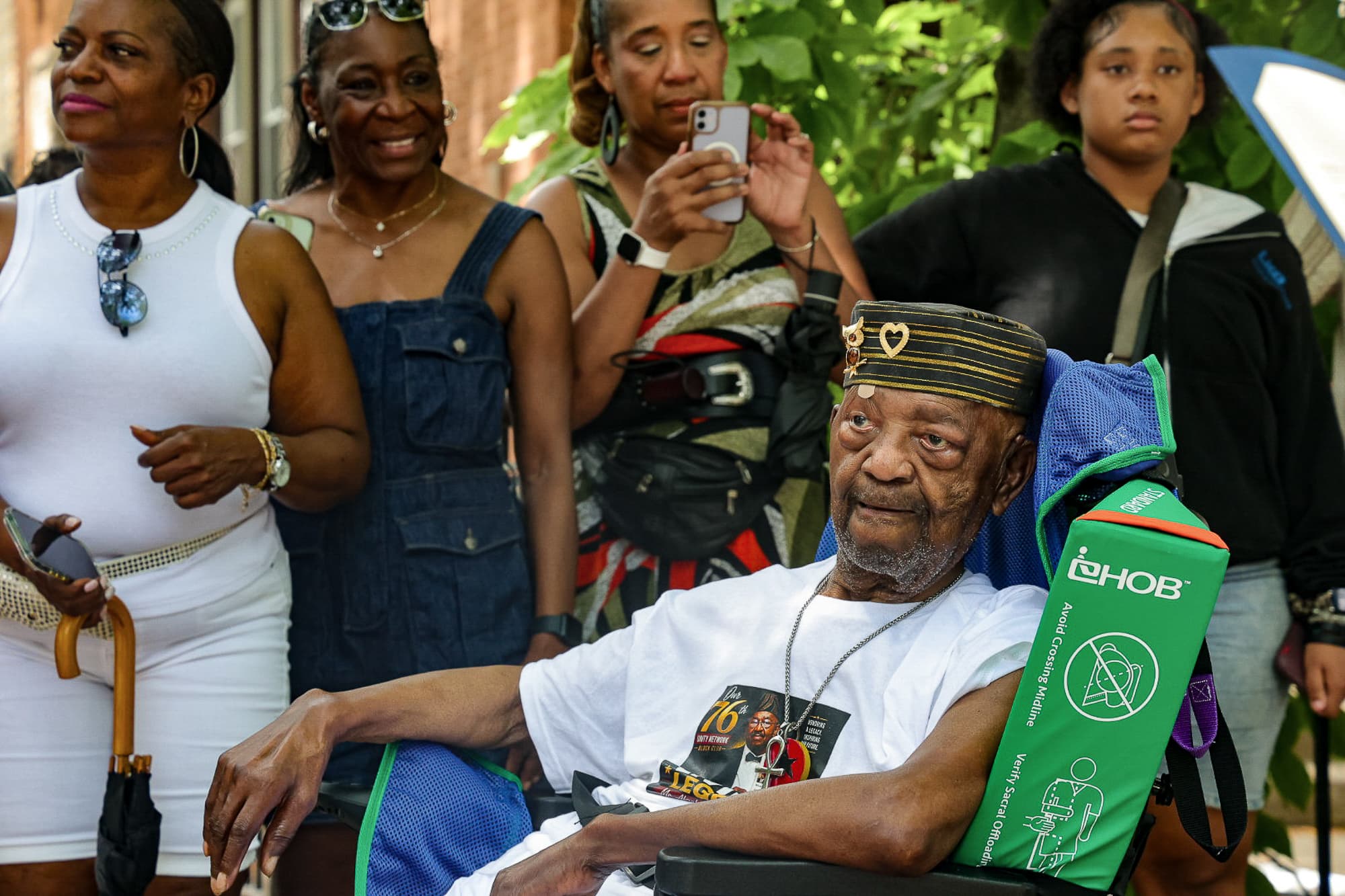
On Saturday, neighbors, friends and family gathered in the 7600 block to unveil a community plaque honoring Abraham Bolden Sr., the first Black Secret Service agent assigned to guard a U.S. president. Bolden, 91, sat surrounded by the block he has called home for decades as the sign bearing his name and image was revealed to the crowd.
"We thank you for your dedicated service to the President, our country, and our community," the plaque reads. Ald. David Moore (17th) and Mayor Brandon Johnson presented Bolden with proclamations recognizing his historic accomplishments, and he was given a plaque marking the occasion.
With his son, Daaim Shabazz, at his side helping him address the crowd, Bolden thanked the people who turned out.
"I deeply appreciate everyone who came out," Bolden said. "Deeply."
The unveiling came more than 60 years after Bolden broke into the Secret Service's White House detail. In 1961, Bolden was working security at a political event at McCormick Place, guarding a restroom, when President John F. Kennedy walked by. Kennedy stopped and asked whether Bolden was with the Secret Service or the Chicago police. When Bolden said Secret Service, Kennedy asked if a Black agent had ever guarded a president. Bolden told him no. Kennedy then asked if Bolden would like to become the first, and he accepted, moving to Washington to join the presidential detail, according to an account Bolden gave a Chicago newspaper in 2010.
Once in Washington, Bolden ran into the kind of treatment Kennedy's invitation was meant to overturn. Bolden has said he was subjected to racial slurs from fellow agents and watched colleagues drink while on duty, conduct he considered a threat to the president's safety.
After Kennedy's assassination in 1963, Bolden tried to bring his concerns about unprofessional conduct and security lapses to the Warren Commission, the body investigating the president's murder. Not long after, he was charged with trying to sell a government document for a $50,000 bribe. Bolden denied the charge for the rest of his life, arguing it was retaliation for speaking up about racism and misconduct inside the agency.
His first trial ended in a hung jury. A second trial convicted him, and he was sentenced to 15 years in prison. He served about three years before his release. It took nearly six decades, but in 2022 then President Joe Biden granted Bolden a full pardon, formally clearing the record he had spent most of his adult life trying to correct.
Saturday's ceremony gave Bolden's Auburn Gresham neighbors a chance to mark that history in a way visible to anyone who drives down the block. Sonja Brown James, secretary of the 76th and Sangamon block club, whose family has lived there since the 1960s alongside the Boldens, helped hand out flyers around the neighborhood to make sure people showed up. She described Bolden as a "root" of the block, someone whose presence has outlasted the turnover of decades on that stretch of Sangamon.
Travis Johnson, a friend of Bolden's who helps the retired agent's caregiver, Virginia Washington, with errands and housework, said the recognition matters most because Bolden is alive to see it.
"Any type of recognition that he's given while he's still here is great," Johnson said. "It's wonderful that he's being recognized. So I think that it lifts his spirits up a little bit too, not being able to get around as much as he used to."
Bolden's son, Daaim Shabazz, an associate professor of global business at Florida A&M University, was a young child when his father was arrested. He has spent years pushing to get his father's story told and his name cleared, work that helped lead to the 2022 pardon.
The plaque is now installed in the 7600 block of South Sangamon Street, a short walk from the house where Bolden lives with his caregiver, marking the spot where his neighbors chose to place his name after more than 60 years.